


National Geographic 1991 June
Publisher: National Geographic
Format: Paperback
ISBN: none
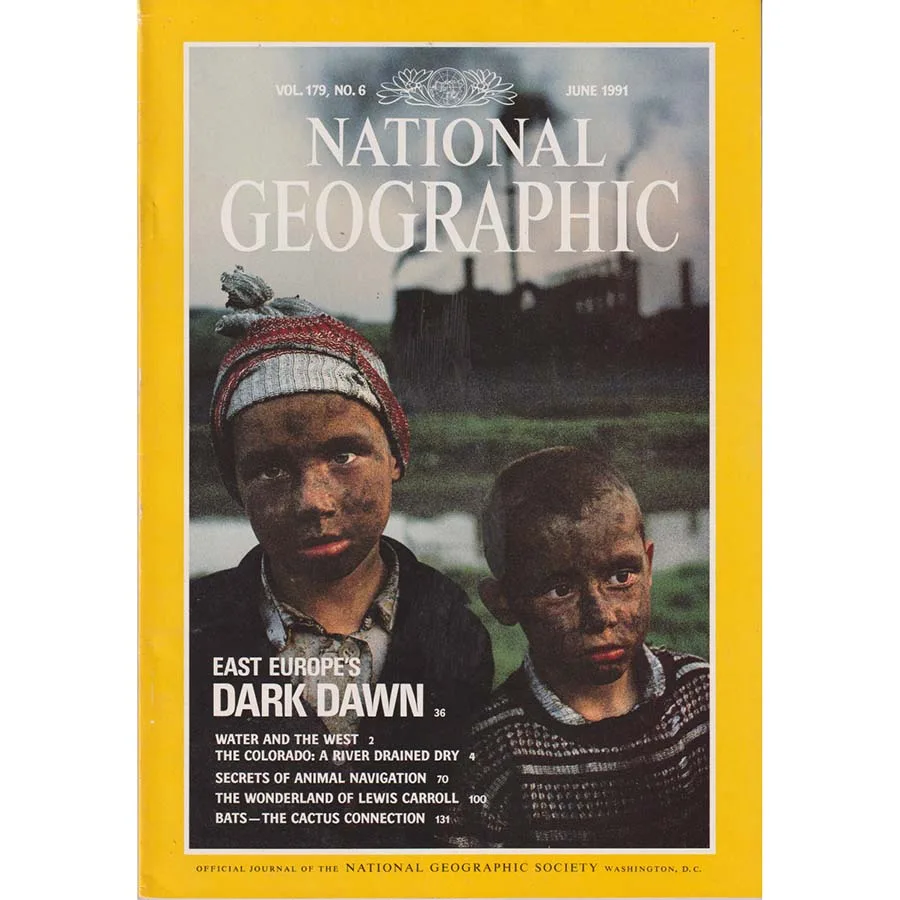
National Geographic, June 1991: the issue that looks you straight in the eye, shows you two coal-smudged kids in front of a smoking industrial skyline, and says, very calmly, “Yes. This is also geography.” No sunsets. No safari glamour. Just the gritty, human kind of landscape where the air has a job and the horizon is mostly machinery.
The headline feature, East Europe’s Dark Dawn, is pure early-90s Nat Geo time-capsule: the Cold War is wobbling towards its endgame, borders and economies are shifting, and the magazine is capturing the lived reality of transition—not as an abstract political idea, but as soot, hard work, uncertainty, and people trying to get on with it. The cover image does a lot in one frame: childhood, industry, fatigue, resilience, and that unsettling sense that “progress” often comes with a very literal layer of dirt.
And the irony is that this is June—supposedly the month of light—and yet here you are, handed a “dark dawn.” National Geographic is basically saying: summer doesn’t arrive everywhere the same way, and history doesn’t wait for your calendar. It’s a strong cover, and it sets the tone for an issue that’s more thoughtful than breezy: big themes, real consequences, and the sense of a world rearranging itself in front of the camera.
But—because Nat Geo can’t help itself—the rest of the issue is a glorious zig-zag across topics that shouldn’t belong together, yet somehow do:
-
Water and the West / The Colorado: A River Drained Dry – a one-two punch that feels almost prophetic now. The American West’s relationship with water: part engineering, part myth, part argument, and part looming reality check. Nat Geo does this well: beautiful landscapes with a quiet spreadsheet of consequences underneath.
-
Secrets of Animal Navigation – a palate cleanser of pure wonder. Birds, insects, sea creatures, magnets, stars, smell, and the unsettling fact that a pigeon can probably find home better than you can find your parked car.
-
The Wonderland of Lewis Carroll – yes, really. From industrial Eastern Europe to the mind that gave us Wonderland. It’s one of those Nat Geo choices that looks odd until you realise the magazine loves mapping any world—physical or imagined—and treating literature like a landscape you can wander through.
-
Bats—The Cactus Connection – and here’s your wonderfully niche Nat Geo trap: you think you’ll skim it, then you’re suddenly deeply invested in desert ecosystems, nocturnal pollinators, and the idea that bats are basically night-shift gardeners holding entire habitats together.
Condition: Good, which is what you want from a 1991 issue: sturdy, readable, and still carrying that old-school National Geographic heft—long articles, serious photography, and an attention span that assumes you’re capable of sitting still and absorbing a whole world. Sold by Crappy Old Books, naturally, because the best place to pick up a gritty post-Cold-War snapshot plus rivers, bats, animal GPS, and literary wonderlands is a seller whose name suggests treasure hidden in a slightly chaotic stack.
If you like your National Geographic with less “ooh pretty” and more “oof, reality”—June 1991 is a cracking, sobering, strangely fascinating read. It’s the kind of issue that reminds you the planet isn’t just scenery. It’s systems. And people. And smoke on the horizon.
Keep browsing: See more National Geographic books Other books by National Geographic
